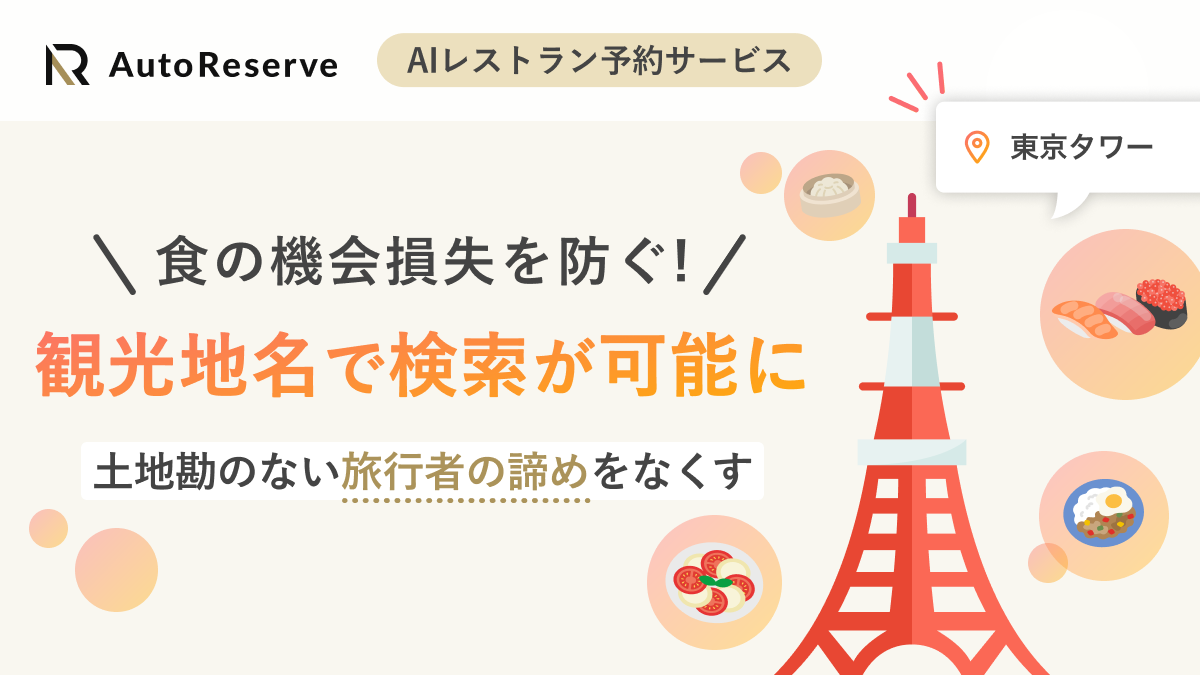
We are pleased to announce the release of the "Tourist Spot Search" function for AutoReserve, our AI-powered restaurant reservation service. This new feature allows users to search for restaurants using tourist destination names. It solves a key challenge for travelers unfamiliar with local station names, enabling them to directly find restaurants using landmark names such as "Tokyo Tower" or "Himeji Castle.”
Background: The Booming Inbound Tourism Market and Overlooked Dining Challenges
In 2024, the number of inbound visitors to Japan reached 36.87 million, with tourism consumption hitting 8.1395 trillion yen, both record highs. (*1)
Compared to pre-pandemic 2019, the number of visitors increased by 15.6% and consumption grew by 69.1%, indicating a strong recovery in the inbound market. As the government aims for 60 million visitors and 15 trillion yen in consumption by 2030, the importance of Tourism DX (Digital Transformation) is increasing. (*2)
Despite this boom, the "dining" challenges faced by tourists at their destinations have often been overlooked. While "experience-based consumption" at tourist spots has become a trend, conventional restaurant search services are primarily based on "station names" or "area names." This presents a structural problem, making intuitive searches starting from a tourist spot difficult.
(*1) Source: Japan National Tourism Organization (JNTO) (https://www.jnto.go.jp/news/press/20250115_monthly.html), Japan Tourism Agency (https://www.mlit.go.jp/kankocho/news02_00024.html)
(*2) Source: Japan National Tourism Organization (JNTO) (https://www.jnto.go.jp/news/m20250501_1.pdf)
Development Background: The Common Challenge of "Not Knowing the Station Name"
The difficulty of "wanting to find a restaurant near a tourist destination but being unable to search without knowing the station name" is a challenge common to both international and domestic travelers.
For example, even if a user wants to "eat Italian near Tokyo Tower," they may not immediately know the closest station. If they want to "enjoy Kyoto cuisine near Kiyomizu-dera Temple," they may be confused about which station to use for their search, such as "Kiyomizu-Gojo" or "Gion-Shijo." This situation is a significant source of stress for travelers unfamiliar with the geography, often leading to them "giving up" or "settling for somewhere else," resulting in a lost consumption opportunity.
In fact, AutoReserve's search data showed a significant volume of searches by tourist spot names, particularly from international tourists. Furthermore, many destinations, such as the "Kurobe Dam" or "Mont-Saint-Michel," do not have a nearby station at all, making traditional station-based searches ineffective in these travel scenarios.
Hello Inc. recognized this issue of "not knowing the station" or "no station existing" as a structural problem affecting both travelers and restaurants, leading us to develop the Tourist Spot Search function.
Feature Details: Enabling Intuitive, Landmark-Based Restaurant Searches
- Autocomplete Suggestions for Tourist Spots
When users begin typing a landmark name like "Tokyo Tower," "Himeji Castle," "Tsutenkaku," or "Okinawa Churaumi Aquarium," relevant suggestions automatically appear for easy selection. This supports major destinations not only in Japan but also worldwide, such as "Niagara Falls" or "Buckingham Palace."
- Combined Search with Cuisine Categories
Users can combine landmarks with cuisine types, such as "Tokyo Tower x Italian" or "Kiyomizu-dera x Kyoto Cuisine." This meets the diverse needs of inbound tourists, seamlessly connecting sightseeing with dining experiences.
- Multilingual Support
Leveraging AutoReserve's strength in multilingual support (including Japanese, English, Chinese, and Korean), users can search for tourist spots in their native language. This breaks down language barriers, enabling restaurant search and reservation anytime, anywhere.
Social Significance: Preventing Missed Dining Opportunities and Contributing to the Regional Economy
The Tourist Spot Search function extends beyond mere convenience; it holds social significance by preventing lost consumption opportunities and contributing to regional economic revitalization.
- Driving Traffic to Nearby Restaurants and Creating New Customer Acquisition Channels
This feature creates a new acquisition channel for restaurants near tourist spots that were previously overlooked due to the "station name" barrier. It presents a significant business opportunity, especially for hidden gems located away from stations or establishments situated right in front of landmarks that were hard to find via conventional search.
- Enhancing Traveler Satisfaction and Boosting Consumption
By enabling travelers to smoothly realize their desired dining experiences at tourist destinations, overall trip satisfaction improves. Eliminating the frustration of "wanting to eat but not being able to find a place" allows consumption intent to translate into actual spending, contributing to the maximization of inbound tourism consumption.

